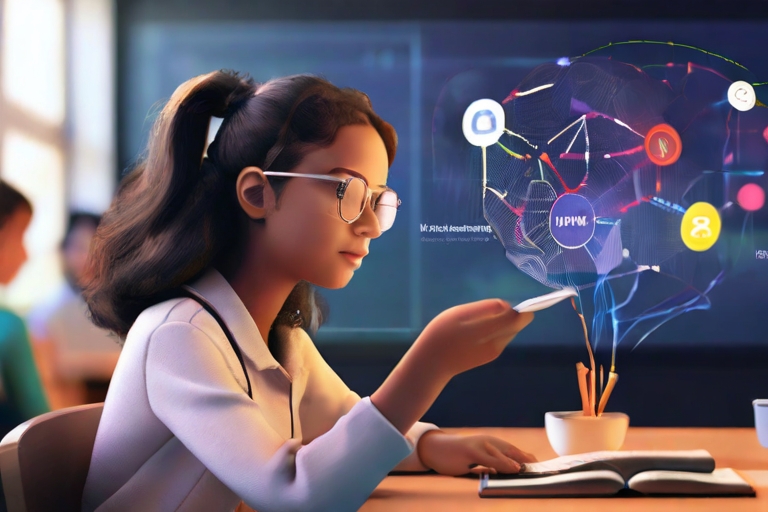
NVIDIA and Microsoft recently announced a toolkit that accelerates the development of AI applications on RTX AI PCs. This partnership has the intention of bringing local AI to more developers, enabling them to utilize the RTX GPUs for various AI workflows including AI agents, application assistants, and digital humans.
Innovative Developments on the Interaction with Digital Humans
One of the major points of importance in this joint venture is the improvement of the interaction with the audience using multi-modal small language models. NVIDIA has presented James Mohamed’s’ an interactive NVIDIA proficient digital human who performs inputs through NIM micro services, NVIDIA ACE, and ElevenLabs to yield natural and effective responses. NVIDIA’s ACE incorporates a number of digital human technologies and makes agents, assistants and avatars alive by allowing them to see and comprehend their environments more deeply.
For this degree of realism, NVIDIA developed the Nemovision-4B-Instruct model that can use both text and images and is proficient in role performing with the right optimization for speed. This model utilizes the NVIDIA VILA and NVIDIA NeMo frameworks for efficient distillation, pruning, and quantization so that it is small enough to work on RTX GPUs without affecting performance. This progress enables virtual humans to interpret visual representations in a natural environment as well as in a screen setting, responding appropriately to such representations, and facilitating an environment where virtual humans can think and arm themselves with little user intervention while performing actions.
On top of this, NVIDIA also presented the Mistral NeMo Minitron 128k Instruct family, which together form a working set of small language models with a large context capable of sustaining hyper-activating interactions of virtual humans. The models are produced in 8B-, 4B-, and 2B-parameter variations, which allow varying performance in terms of speed, memory, and precision on RTX AI computers. Their operation can accommodate large datasets within one operation cycle, eliminating the need for data fragmentation and subsequent reassembly. Designed in a GGUF format, these models are more effective at low powered devices and are multi-language compatible.
Optimizing AI Models with TensorRT Model Optimizer
There are several problems encountered by the developers in moving AI models to PC environments as several resources such as memory and compute power have barriers. To overcome this, NVIDIA announced a scaling up of the TensorRT Model Optimizer(ModelOpt) that is expected to provide developers dealing with Windows a better means of optimizing models for deployment on ONNX Runtime. It has recently been updated so that models can be optimized into many checkpoints of ONNX in order to be deployed in ONNX runtime environments which incorporate the CUDA, TensorRT, and DirectML GPU execution providers.
Monte Carlo Tree Search as a component of the TensorRT-ModelOpt is fused with quantitative strategies like INT4-Activation Aware Weight Quantization to help achieve optimization of spatial occupancy of the model while improving the throughput performance on RTX GPUs. After deployment, models can achieve up to 2.6 epochs lower memory footprint relative to FP16 models, faster throughputs with little depreciation in accuracy making it possible for them to run on more conventional PCs.
The implications for developers and the users
Seeing NVIDIA and Microsoft work together is significant in the development of AI and more importantly in providing a range of high-end AI applications to ordinary home consumer hardware. Having such applications is certainly going to help the developers who craft such applications as they provide a means to enable the AI models to be optimized and deployed locally, thus reducing lag and making the applications open and trustworthy.
For the users, this means better experiences in several applications ranging from more engaging digital helpers and AI-based image and video editing capabilities to sophisticated content generation tools. Also, the ability to run large AI models locally resolves some of the issues related to data protection as any sensitive data can be processed directly on the user’s device without sending it to remote servers.
Future Outlook
As the future AI develops, the demand for more robust hardware able to work with heavy AI models on-site will increase. The developments showcased during Microsoft Ignite point to an evolution in AI applications where performance parameters will not be the only asset as new AI’s features will be altered by computing infrastructure.
Now developers possess more powerful tools so their end products will be more dynamic and responsive with regard to the context, thus creating headroom in such industries as virtual reality, games and professional content creation. A trend towards more unified AI systems capable of perception and interaction similar to humans is reinforced by a focus on multimodal models that have a high comprehension of both text and images.
In closing, the collaboration between NVIDIA and Microsoft during the Microsoft Ignite conference marked an impressive milestone for the democratization of AI development. By utilizing RTX AI PCs, which help developers distribute complex AI models, they are paving the way for a variety of applications that are more robust, efficient, and available to a wider range of users. Apart from broadening the scope of AI applications, this partnership will also help in further advancements in how technology will be experienced in the future.